DeepSeek's new bargain model accelerates AI's race to zero
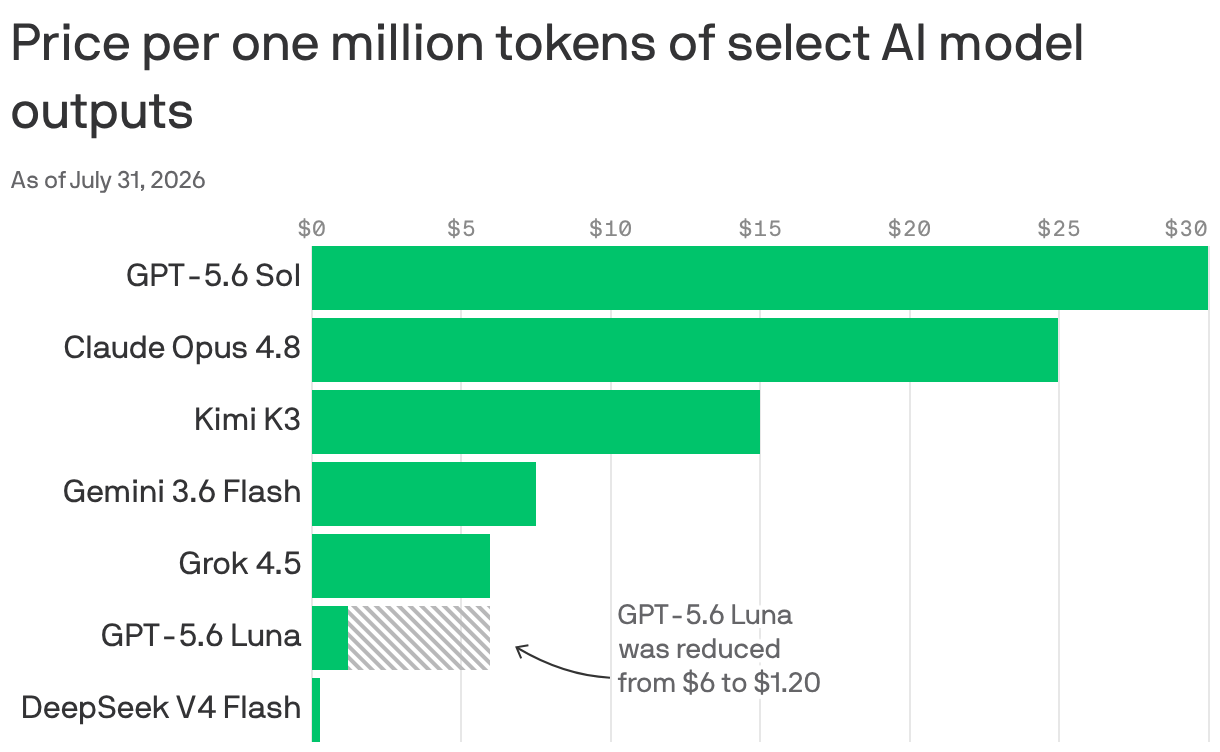
<div>Data: Axios research; Chart: Sara Wise/Axios</div><p>Chinese AI lab <a href="https://www.axios.com/2026/06/16/microsoft-copilot-cowork-tokenmaxxing-cowork" target="_blank">DeepSeek</a> released a powerful new coding model Friday that charges pennies for vast amounts of code — the latest sign that some of the smartest software on Earth is rapidly becoming a <a href="https://www.axios.com/2026/07/06/ornn-gpu-compute-commodity" target="_blank">commodity</a>.</p><p><strong>Why it matters: </strong>Tech giants are pouring <a href="https://www.axios.com/2026/05/05/ai-spending-stocks-economy" target="_blank">hundreds of billions of dollars</a> into the computing infrastructure powering the AI revolution. Yet the intelligence that infrastructure produces is getting cheaper by the week.</p><hr><p><strong>Zoom in: </strong>DeepSeek is the same Chinese startup that <a href="https://www.axios.com/2025/01/27/deepseek-ai-model-china-openai-rival" target="_blank">ignited a market meltdown</a> last January by showing it could build a world-class AI model with far fewer resources than its U.S. rivals.</p><ul><li>Its newest model, V4 Flash, <a href="https://huggingface.co/deepseek-ai/DeepSeek-V4-Flash-0731" target="_blank">performs</a> close to the level of Anthropic's Claude Opus 4.8, one of the industry's most capable systems, on tests of complex coding and autonomous software tasks. </li><li>On <a href="https://x.com/arena/status/2083348755559207047?s=20" target="_blank">Arena.ai's crowdsourced leaderboard</a> for front-end coding, V4 Flash debuted ahead of Opus 4.8 — while delivering the best performance for its price among any model in its class.</li><li>The price gap is staggering: DeepSeek charges about 28 cents for the same amount of output that costs $25 on Opus 4.8 — a 99% discount.</li></ul><p><strong>Zoom out: </strong>With Chinese models like <a href="https://www.axios.com/2026/07/17/china-ai-kimi-k3-open-source-anthropic-opus" target="_blank">Kimi K3</a> bearing down on the U.S. market, July ushered in a full-scale price war across the AI landscape.</p><ul><li><strong>OpenAI</strong> <a href="https://www.axios.com/2026/07/30/openai-cuts-prices-gpt-terra-luna5" target="_blank">slashed the price</a> of GPT-5.6 Luna — its fastest, cheapest model for high-volume tasks — by 80% on Thursday, only three weeks after its launch.</li><li><strong>Google</strong> released three new <a href="https://www.axios.com/2026/07/21/google-gemini-ai-models" target="_blank">Gemini</a> "flash" models all focused on efficiency.</li><li><strong>SpaceXAI </strong>released <a href="https://www.axios.com/2026/07/08/spacexai-grok-new-model" target="_blank">Grok 4.5</a>, Elon Musk's most capable model yet for coding, research and autonomous tasks, at the same price OpenAI originally charged for Luna before this week's cut.</li><li><strong>Meta </strong>quietly reversed course on its longtime embrace of open weights with <a href="https://www.axios.com/2026/07/09/meta-ai-spark-model-update-developer" target="_blank">Muse Spark 1.1</a>, a closed-source model priced aggressively for developers.</li></ul><p><strong>The other side: </strong>Anthropic remains the clearest holdout, keeping its top-tier Claude models at premium pricing and betting that developers will pay extra for safety and precision.</p><p><strong>Between the lines: </strong>When a product becomes a commodity, buyers care less about who made it and more about what it costs. Think electricity or gasoline: Few people know which power plant supplied their home or which refinery produced the fuel in their tank.</p><ul><li>AI is heading that way fast. As the performance gap between top-tier models is shrinking, many AI applications no longer depend on a single provider, giving buyers more leverage to shop on price.</li><li>"At some point, the next model doesn't matter to you," says Zack Kass, OpenAI's former head of go-to-market and a global AI adviser. He calls the phenomenon "diminishing model returns."</li></ul><p><strong>What to watch: </strong>That could create a lucrative market for "intelligent routers," Vinesh Sukumar, Qualcomm's vice president of AI product management, told Axios.</p><ul><li>Those systems would automatically choose the best model for each task based on capability, speed and price — further weakening the power of any one lab to command a premium.</li><li>For frontier AI labs, that could pose an existential challenge: Spending tens of billions to build a slightly smarter model may buy only a temporary lead, without creating lasting pricing power.</li></ul><p><strong>Reality check: </strong>Falling prices do not necessarily doom the frontier labs if cheaper AI unleashes vastly more demand.</p><ul><li>OpenAI is betting that companies will use its models so extensively that enormous volume can compensate for thinner margins.</li><li>"We will have so much usage of our models that we do not need to be a gigantically high-margin business to be able to afford model training," CEO Sam Altman said on the Invest Like the Best <a href="https://www.youtube.com/watch?v=XDB5beon4DY" target="_blank">podcast</a>.</li></ul><p><strong>The bottom line: </strong>The U.S. and China are both racing to make intelligence abundant. Now someone has to prove abundance can still be profitable.</p>
<div>Data: Axios research; Chart: Sara Wise/Axios</div><p>Chinese AI lab <a href="https://www.axios.com/2026/06/16/microsoft-copilot-cowork-tokenmaxxing-cowork" target="_blank">DeepSeek</a> released a powerful new coding model Friday that charges pennies for vast amounts of code — the latest sign that some of the smartest software on Earth is rapidly becoming a <a href="https://www.axios.com/2026/07/06/ornn-gpu-compute-commodity" target="_blank">commodity</a>.</p><p><strong>Why it matters: </strong>Tech giants are pouring <a href="https://www.axios.com/2026/05/05/ai-spending-stocks-economy" target="_blank">hundreds of billions of dollars</a> into the computing infrastructure powering the AI revolution. Yet the intelligence that infrastructure produces is getting cheaper by the week.</p><hr><p><strong>Zoom in: </strong>DeepSeek is the same Chinese startup that <a href="https://www.axios.com/2025/01/27/deepseek-ai-model-china-openai-rival" target="_blank">ignited a market meltdown</a> last January by showing it could build a world-class AI model with far fewer resources than its U.S. rivals.</p><ul><li>Its newest model, V4 Flash, <a href="https://huggingface.co/deepseek-ai/DeepSeek-V4-Flash-0731" target="_blank">performs</a> close to the level of Anthropic's Claude Opus 4.8, one of the industry's most capable systems, on tests of complex coding and autonomous software tasks. </li><li>On <a href="https://x.com/arena/status/2083348755559207047?s=20" target="_blank">Arena.ai's crowdsourced leaderboard</a> for front-end coding, V4 Flash debuted ahead of Opus 4.8 — while delivering the best performance for its price among any model in its class.</li><li>The price gap is staggering: DeepSeek charges about 28 cents for the same amount of output that costs $25 on Opus 4.8 — a 99% discount.</li></ul><p><strong>Zoom out: </strong>With Chinese models like <a href="https://www.axios.com/2026/07/17/china-ai-kimi-k3-open-source-anthropic-opus" target="_blank">Kimi K3</a> bearing down on the U.S. market, July ushered in a full-scale price war across the AI landscape.</p><ul><li><strong>OpenAI</strong> <a href="https://www.axios.com/2026/07/30/openai-cuts-prices-gpt-terra-luna5" target="_blank">slashed the price</a> of GPT-5.6 Luna — its fastest, cheapest model for high-volume tasks — by 80% on Thursday, only three weeks after its launch.</li><li><strong>Google</strong> released three new <a href="https://www.axios.com/2026/07/21/google-gemini-ai-models" target="_blank">Gemini</a> "flash" models all focused on efficiency.</li><li><strong>SpaceXAI </strong>released <a href="https://www.axios.com/2026/07/08/spacexai-grok-new-model" target="_blank">Grok 4.5</a>, Elon Musk's most capable model yet for coding, research and autonomous tasks, at the same price OpenAI originally charged for Luna before this week's cut.</li><li><strong>Meta </strong>quietly reversed course on its longtime embrace of open weights with <a href="https://www.axios.com/2026/07/09/meta-ai-spark-model-update-developer" target="_blank">Muse Spark 1.1</a>, a closed-source model priced aggressively for developers.</li></ul><p><strong>The other side: </strong>Anthropic remains the clearest holdout, keeping its top-tier Claude models at premium pricing and betting that developers will pay extra for safety and precision.</p><p><strong>Between the lines: </strong>When a product becomes a commodity, buyers care less about who made it and more about what it costs. Think electricity or gasoline: Few people know which power plant supplied their home or which refinery produced the fuel in their tank.</p><ul><li>AI is heading that way fast. As the performance gap between top-tier models is shrinking, many AI applications no longer depend on a single provider, giving buyers more leverage to shop on price.</li><li>"At some point, the next model doesn't matter to you," says Zack Kass, OpenAI's former head of go-to-market and a global AI adviser. He calls the phenomenon "diminishing model returns."</li></ul><p><strong>What to watch: </strong>That could create a lucrative market for "intelligent routers," Vinesh Sukumar, Qualcomm's vice president of AI product management, told Axios.</p><ul><li>Those systems would automatically choose the best model for each task based on capability, speed and price — further weakening the power of any one lab to command a premium.</li><li>For frontier AI labs, that could pose an existential challenge: Spending tens of billions to build a slightly smarter model may buy only a temporary lead, without creating lasting pricing power.</li></ul><p><strong>Reality check: </strong>Falling prices do not necessarily doom the frontier labs if cheaper AI unleashes vastly more demand.</p><ul><li>OpenAI is betting that companies will use its models so extensively that enormous volume can compensate for thinner margins.</li><li>"We will have so much usage of our models that we do not need to be a gigantically high-margin business to be able to afford model training," CEO Sam Altman said on the Invest Like the Best <a href="https://www.youtube.com/watch?v=XDB5beon4DY" target="_blank">podcast</a>.</li></ul><p><strong>The bottom line: </strong>The U.S. and China are both racing to make intelligence abundant. Now someone has to prove abundance can still be profitable.</p>
FOMOGRAM SENTINEL GRAVITY TELEMETRY
Neutral market report for CRYPTO: Balanced telemetry.
Explore all verified news, research, and global sources for CRYPTO.