Brent's $96 Pivot: Hormuz Diplomacy Calms Crude Rally
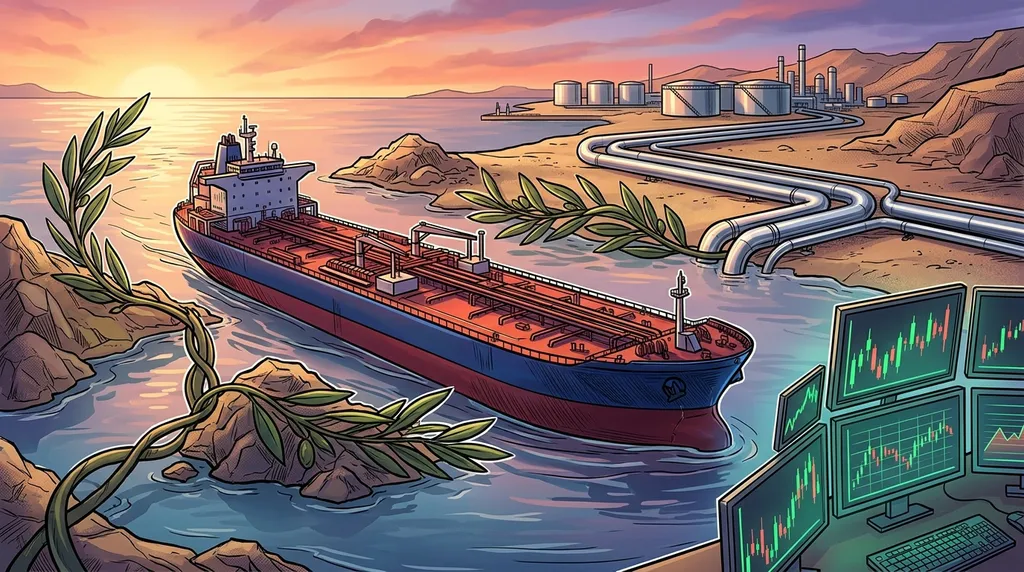
Diplomatic overtures surrounding the Strait of Hormuz and Saudi Aramco's pipeline restoration pulled front-month Brent crude contracts back toward $96.50 on September 25 as energy markets weighed geopolitical de-escalation against persistent Red Sea maritime transit risks.
Diplomatic Thaw in the Strait of Hormuz Eases War Risk
Front-month Brent crude contracts retreated toward the $96.50 pivot zone as reports surfaced that United States and Iranian interlocutors revived discussions modeled on an earlier June maritime framework. The diplomatic engagement seeks to establish established maritime transit corridors through the Strait of Hormuz, an indispensable international shipping artery that transports approximately twenty percent of the world's daily petroleum supply.
The mere emergence of credible bilateral communication immediately punctured the speculative war-risk premium that had previously propelled crude benchmarks within striking distance of the century mark. Energy trading desks and institutional commodity hedge funds moved swiftly to unwind defensive long positions, recalibrating implied volatility surfaces and allowing physical delivery curves to normalize toward baseline supply fundamentals.
Aramco Petroline Restoration Secures Yanbu Export Corridors
Simultaneously easing regional bottleneck anxiety, state-owned Saudi Aramco completed technical operational checks along its flagship Petroline, the East-West Pipeline that spans over twelve hundred kilometers across the Arabian Peninsula. The conduit provides an essential overland artery, transporting five million barrels of crude daily from rich eastern oilfields to the Red Sea port of Yanbu, entirely circumventing the Persian Gulf chokepoint.
The full operational readiness of Yanbu’s deepwater export terminals guarantees unencumbered global distribution even under severe maritime escalation scenarios. Refiners across Mediterranean Europe and the Asia-Pacific received formal confirmation of scheduled export loadings, reassuring international supply aggregators and neutralizing localized structural shortages across the seaborne light crude trade.
Wall Street Rallies as Energy Inflation Pressures Recede
The deflation of crude risk premiums triggered an immediate sigh of relief across global equity and bond markets. On Wall Street, the Dow Jones Industrial Average surged more than 400 points within hours of the diplomatic disclosures, led by cyclicals, industrial transports, and consumer retail operators who benefit directly from depressed fuel input expenditures.
Benchmark sovereign bond yields settled back from multi-week highs as institutional fixed-income allocators downgraded near-term headline inflation projections. Central bankers navigating delicate monetary easing cycles had warned that persistent triple-digit petroleum costs would delay expected policy rate cuts; crude’s retreat toward $96 provides welcome operational breathing room for broader macroeconomic stabilization.
Structural Red Sea Risks Cap Downside Below Ninety-Six Dollars
Despite diplomatic optimism, physical commodity strategists caution against aggressive short positioning below the critical $96 support threshold. Maritime security risks remain acute throughout the southern Bab-el-Mandeb strait, where commercial container and tanker traffic continues to confront drone and anti-ship missile threats, forcing commercial shipping syndicates to maintain steep war-risk insurance surcharges.
Furthermore, global commercial petroleum inventories remain structurally depleted across key OECD storage hubs, leaving little physical buffer against unexpected production outages. While diplomatic progress and pipeline alternatives have successfully arrested the immediate upside panic, the structural interplay between tight physical spare capacity and simmering geopolitical realities anchors Brent crude within a balanced, high-volatility consolidation regime.
FOMOGRAM SENTINEL GRAVITY TELEMETRY
The cooling of crude risk premiums below $97 directly dampens global headline inflation expectations, providing critical macro tailwinds for risk assets while keeping oil locked in a high-volatility diplomatic consolidation range.
Track live candlestick charts, quantitative telemetry, and active signals for BZ in Terminal Overview.