Uniswap Burns $1M Daily: Robinhood Ignites UNI Supply
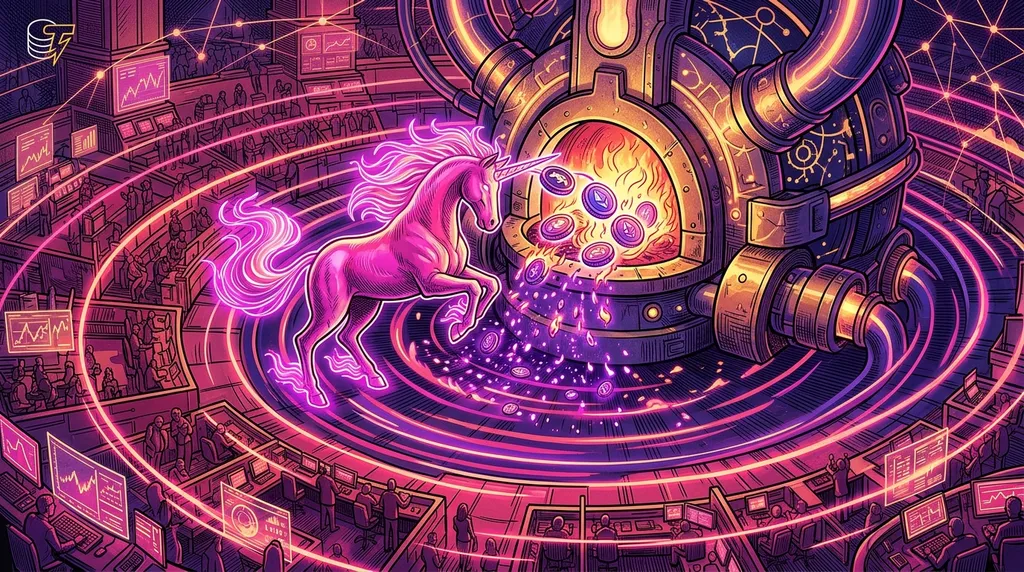
Exploding decentralized trading activity across the newly deployed Robinhood Chain Layer-2 network drove daily Uniswap protocol token burns past $1,000,000 for the first time in history on Friday, permanently incinerating 178,000 UNI tokens in a single 24-hour window and transforming the governance asset into an aggressive deflationary engine.
The Million-Dollar Milestone & Deflationary Inflection
Uniswap has crossed a monumental milestone in decentralized protocol economics. For the first time since the activation of its programmatic fee-sharing and supply reduction mechanism, total daily UNI tokens permanently burned and eliminated from circulating supply exceeded one million dollars in equivalent market value. Across a single twenty-four-hour accounting window, exactly 178,000 UNI tokens were sent to the provable unspendable burn contract, marking a pivotal inflection point from inflationary governance distribution into aggressive net supply deflation.
This structural shift validates the core economic premise of modern decentralized finance: as protocol utility and trading velocity scale across multi-chain execution environments, value capture must accrue directly to the underlying asset through verifiable supply scarcity. The million-dollar daily burn rate represents an annual supply destruction velocity exceeding $365 million, effectively neutralizing historical team vesting schedules and establishing an unprecedented deflationary floor for spot market valuations.
Robinhood Chain Integration & Retail Execution Velocity
The primary catalyst propelling this historic burn volume is the explosive transaction velocity originating from Robinhood Chain. Launched as an institutional-grade, low-latency Layer-2 execution rollup designed to bridge traditional retail brokerage order flow with on-chain automated market maker liquidity, Robinhood Chain has routed tens of millions in decentralized trading volume directly through Uniswap automated liquidity pools.
On-chain settlement data reveals that of the 178,000 UNI incinerated during yesterday's session, an astonishing 144,000 tokens—representing over 80% of total burn volume—stemmed directly from Robinhood Chain swap fees. Retail users executing commission-free crypto trades within the brokerage interface are unknowingly interacting with underlying Uniswap smart contracts, generating high-frequency micro-burn transactions that collectively form an overwhelming institutional burn tide.
On-Chain Liquidity Drainage & Float Contraction
The market mechanics of continuous automated supply destruction are beginning to profoundly impact spot order book dynamics. Unlike protocol staking models that merely lock tokens temporarily while leaving future circulating supply overhang intact, the Uniswap burn mechanism permanently destroys private keys to the underlying tokens, permanently reducing liquid float. Large OTC market makers and liquidity providers are reporting dwindling secondary inventory across centralized exchanges, forcing proprietary trading desks to bid higher in order to replenish operational inventory.
Blockchain analytics further confirm that decentralized liquidity pools on Ethereum mainnet and leading Layer-2 networks are absorbing higher trading volumes with lower slippage, creating a self-reinforcing flywheel effect. As liquidity depth expands, institutional block traders are increasingly favoring Uniswap over centralized venues, which in turn generates higher protocol fee revenue and fuels even larger programmatic token burns.
Market Outlook & The Valuation Re-Rating Framework
From a fundamental valuation perspective, institutional analysts are aggressively revising their discounted cash flow and fee-to-token models for the UNI ecosystem. For years, critics argued that decentralized governance tokens lacked direct economic linkage to protocol cash flows. The undeniable execution of a million dollars in daily supply destruction has demolished that historical discount, positioning UNI alongside traditional high-margin fintech infrastructure assets.
As trading velocity continues to accelerate across both Robinhood Chain and traditional DeFi rollups, market participants are pricing in sustained supply contraction through the remainder of the trading year. Technical chart structure indicates strong structural support forming above key liquidity nodes, with institutional allocators projecting that continued burn momentum will serve as the primary fundamental springboard toward multi-month valuation highs.
FOMOGRAM SENTINEL GRAVITY TELEMETRY
Crossing the million-dollar daily burn threshold permanently alters UNI tokenomics, creating persistent net negative issuance that directly benefits spot token holders.
Track live candlestick charts, quantitative telemetry, and active signals for UNI in Terminal Overview.